

Covenant Character Responsibility
The Serpent’s Tongue, the Open Gate, and the Final Covenant Choice—from Eden and Babylon to Communism, Political Islam, and the Sleeping American House

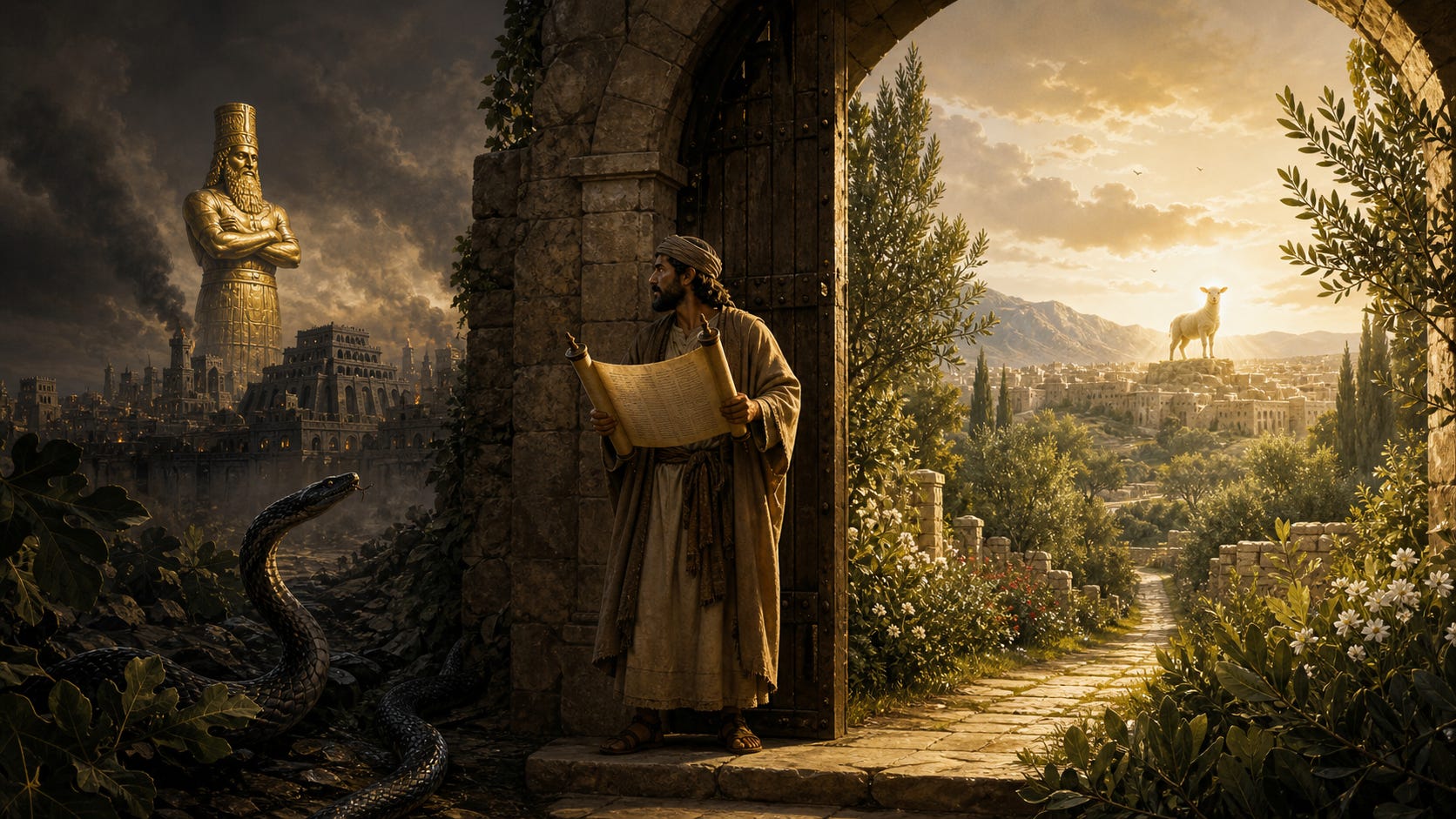
It is never about hating the people; it is about testing the system.
It is about opening the Book and asking whether the words, laws, institutions, traditions, and governing claims placed over people agree with the instruction of יהוה.
But that distinction does not remove personal responsibility.
The people are not the system. The people are still responsible for what they receive, what they repeat, what they obey, and what they build.
That is the matter before us.
Scripture does not hide the darkness of rulers, nations, religious institutions, merchants, households, or empires behind polite language. It tells us what יהוה commanded. It records what people did. It identifies the breach, hears the witnesses, names the deceiver, examines the fruit, and renders judgment.
It does not call slavery a labor disagreement.
It does not call judicial murder a property dispute.
It does not call idolatry civic participation.
It does not call false weights innovative commerce.
It does not call the devouring of widows’ houses effective religious administration.
The Book speaks in courtroom language:
Here is the governing Word.
Here is what happened.
Here is who acted.
Here is who benefited.
Here is who suffered.
Here is the testimony.
Here is the breach.
Here is the fruit.
This courtroom pattern is the foundation of what I call Covenant Character Responsibility, or CCR.
Covenant Character Responsibility is the obligation of those who bear the Creator’s image to know the Word of the King, guard its meaning, embody His character, tend what He has entrusted, and answer before His court for what they did with that responsibility.
The controlling principle is this:
Testimony concerning the deceiver does not absolve the Covenant bearer, but personal guilt does not erase the guilt of the deceiver.
The man and the woman did not escape responsibility by naming another participant. Their words functioned as testimony before the righteous Judge. The Judge did not accept their testimony as an acquittal, but He did receive it as evidence establishing the chain of the breach. Each participant was judged according to his or her part.
That pattern begins in the garden.
It appears again in Babylon.
It reaches a final expression in Revelation (Ḥazon), where the beast demands worship, the image speaks, commerce is controlled, and the faithful are identified by the Name they bear, the Lamb they follow, and the truth found in their mouths.
The question running through the whole account is not merely, *What religion do you claim?*
The question is:
Whose House do you belong to?
Covenant, Character, and Responsibility
Each word carries weight.
Covenant is the objective order established by יהוה. The Covenant bearer does not invent the terms. He receives them. He may hear and obey, or he may rebel, but he does not possess lawful authority to rewrite the King’s instruction.
Character is the inward formation required to carry responsibility without corrupting it. Authority without Covenant character becomes domination. Knowledge without Covenant character becomes manipulation. Religious language without Covenant character becomes hypocrisy. Political power without Covenant character becomes beastly government.
Responsibility is the obligation to answer.
Responsibility is more than completing an assigned task. It is the obligation to hear, understand, guard, act, and give an account.
CCR therefore asks:
What did יהוה entrust?
What Word governed that trust?
Who was responsible for preserving it?
What outside interpretation entered?
How did that interpretation change perception?
What action followed?
What covering was constructed?
Who benefited from the breach?
Who was harmed?
What judgment followed?
What would repentance and restoration require?
These questions can be used to examine a person, a marriage, a household, an assembly, a school, a medical institution, a corporation, a political party, or a nation.
The same standard must be used for all of them.
Truth belongs to the Kingdom of Heaven, not to man.
The First Covenant Household
Genesis (Berĕshith) begins with a Kingdom, a garden, a man, a woman, and a Word.
יהוה placed the man in the garden to work it and guard it (Genesis 2:15). The Hebrew verbs are ʿavad and shamar. Their range includes working, serving, cultivating, keeping, watching, and guarding (Benner, 2005; Brown et al., 1907).
The man was not placed in the garden as a passive consumer.
He was a servant.
He was a cultivator.
He was a watchman.
He held delegated responsibility inside a jurisdiction that belonged to יהוה.
The provision came from יהוה.
The boundary came from יהוה.
The instruction came from יהוה.
The authority to define good and evil remained with יהוה.
The woman was then given as ʿezer kenegdo—a corresponding strength facing the man. The Hebrew word ʿezer is not the language of an insignificant servant. It is language used elsewhere for powerful help. Kenegdo carries the sense of one corresponding to him, facing him, and standing in necessary relation with him (Benner, n.d.).
The woman was essential to the Covenant household.
She was essential to fruitfulness.
She was essential to multiplication.
She was essential to generational continuity.
She was essential to the building of the house.
The man and his wife carried a shared Covenant vocation. Their responsibilities were not identical, but neither was unnecessary. The garden was to be worked. The Word was to be guarded. The household was to become fruitful. The life given by יהוה was to multiply according to His order.
Then another voice entered the jurisdiction.
The Serpent as an Unauthorized Covenant Interpreter
The serpent did not begin with physical force.
He did not storm the garden.
He did not seize the fruit.
He began with interpretation.
“Is it true that Elohim has said, ‘Do not eat of every tree of the garden’?” (HalleluYah Scriptures, n.d., Genesis 3:1).
The serpent acknowledged that a Word had been given, but he challenged its meaning, scope, consequence, and intention.
He enlarged the prohibition.
He denied the consequence.
He implied a hidden motive.
He presented the boundary as deprivation.
He presented rebellion as enlightenment.
He presented death as advancement.
The tree did not change.
The fruit did not change.
The Word did not change.
The interpretation changed.
Once the interpretation changed, perception changed.
Once perception changed, desire was reorganized.
Once desire was reorganized, action followed.
The serpent did not place a new object in the garden. He placed a new meaning upon an existing object.
That is why the struggle over language is never small.
The serpent’s tongue does not always deny that an act occurred. It changes the moral and legal name of the act.
Deception becomes persuasion.
Coercion becomes cooperation.
Conquest becomes reform.
Confiscation becomes redistribution.
Censorship becomes safety.
Compelled worship becomes unity.
Covenant betrayal becomes liberation.
Once the act is renamed, the charge is weakened.
Once the charge is weakened, the offender is protected.
Once the offender is protected, the witness becomes the accused.
This is not merely inaccurate terminology.
It is courtroom corruption.
Trust Did Not Remove Responsibility
Before the breach, the man had no history of betrayal by his wife.
She had been given to him by יהוה.
She was bone of his bones and flesh of his flesh.
She was his Covenant counterpart.
The fruit came through an established relationship of trust. That helps us understand the path through which the breach moved. It does not absolve the man.
The man had received the instruction from יהוה before the woman was formed. Genesis 3:6 places him with her when she gave him the fruit. First Timothy (Timotiyos Aleph) 2:14 distinguishes the woman’s deception from the man’s participation.
The woman was deceived.
The man ate.
Both participated.
Both answered.
The Covenant bearer remains responsible for knowing the King’s Word even when another interpretation comes through a loved, trusted, educated, appointed, religious, political, medical, or institutional voice.
The man cannot finally say:
My wife gave it to me.
My teacher taught it to me.
My government required it.
My denomination approved it.
My doctor prescribed it.
My party defended it.
My experts defined it.
Influence may explain the path of the breach.
Influence does not erase responsibility.
The Witnesses, the Rival Bridegroom, and the Final Covenant Choice
We must not forget what occurred in the garden courtroom.
The man and his woman stood before the righteous Judge.
The man testified:
“The woman whom You gave to be with me, she gave me of the tree and I ate” (HalleluYah Scriptures, n.d., Genesis 3:12).
The woman testified:
“The serpent deceived me, and I ate” (HalleluYah Scriptures, n.d., Genesis 3:13).
Their testimony did not remove their guilt, but neither should it be dismissed as though it contained no truth.
They identified the chain of the breach.
The woman gave the fruit.
The serpent deceived the woman.
The man ate.
The woman ate.
The Judge heard the witnesses and rendered judgment against every participant.
The man was judged for listening to another voice and failing in his Covenant responsibility.
The woman was judged for receiving and acting upon the serpent’s interpretation.
The serpent was judged for deception and for introducing the breach into the Covenant household.
The courtroom did not accept influence as innocence.
The courtroom did not ignore the deceiver because the humans willingly acted.
The righteous Judge assigned judgment according to the responsibility of each party.
The man and the woman were put outside the House—the garden sanctuary entrusted to them.
But exile was not the final word.
The promise concerning the woman’s SEED was spoken inside the courtroom itself. Judgment and restoration entered the Scriptural account together. The Covenant household was exiled. The serpent’s sentence had already been announced. The promised SEED who would crush the serpent’s head had been declared (Genesis 3:15).
Scripture then develops Covenant through the language of marriage.
יהוה delivered Israel from Pharaoh, brought her to Himself, gave her His instruction, placed His Name upon her, and dwelt among her. When Israel pursued other mighty ones, trusted foreign rulers, and bowed at rival altars, the prophets did not treat those choices as harmless religious variety. They called them Covenant adultery (Hosea [Hoshĕa] 1–3; Jeremiah [Yirmeyahu] 3:6–14; Ezekiel [Yeḥezqĕl] 16).
The bride sought provision from other houses.
She sought protection from other kings.
She gave worship at other altars.
She accepted rival government.
Yet the prophetic witness does not end in abandonment. יהוה promises cleansing, return, the Renewed Covenant, and the restoration of the divided House. Yeshua enters this account as the Bridegroom, not as the founder of a disconnected religion (Matthew 9:14–17; John 3:27–30; Revelation 19:6–9).
That is why the language of the rival bridegroom matters.
The pattern moves from the garden to Babylon.
But we must preserve an important textual distinction.
Daniel (Dani’ĕl) 2 records Nebuchadnezzar’s dream of a great statue. Its head was fine gold, its chest and arms were silver, its abdomen and thighs were bronze, its legs were iron, and its feet were a divided mixture of iron and clay. Daniel told the king, “You are the head of gold” (HalleluYah Scriptures, n.d., Daniel 2:38).
Daniel 3 records a different image.
Nebuchadnezzar made an image entirely of gold and commanded peoples, nations, and languages to bow before it. Daniel 2 and Daniel 3 are connected by kingship, image, empire, and the contest of kingdoms, but they are not the same object. We must not merge the two scenes carelessly.
In Daniel 2, the statue represents successive beastly reigns that are finally struck and ended by the reign established by Elohim in the heavens.
In Daniel 3, the king constructs an image and demands embodied allegiance.
Bow.
Join the public order.
Submit the body.
Acknowledge the king’s image.
Accept Babylon’s protection and place within the system under Babylon’s terms.
Refusal meant exclusion and death.
The faithful Judean men understood what was being demanded. Babylon was acting as a rival bridegroom. It did not ask only for civil cooperation. It demanded the bodily sign of worship.
Shadrach, Meshach, and Abednego could serve within Babylon.
They would not belong to Babylon.
They could recognize the king’s civil authority.
They could not give him the worship that belonged to יהוה.
They refused to sign Babylon’s covenant with their bodies.
Their refusal was Covenant fidelity.
Nebuchadnezzar called it rebellion.
יהוה made it testimony.
The furnace became a courtroom. The king pronounced death. The righteous Judge overturned Babylon’s claim of final jurisdiction and stood with His servants in the fire.
Revelation (Ḥazon) returns humanity to the same Covenant decision.
There is another beastly government.
There is another image.
There is another demand for worship.
There is another economic order controlling who may buy and sell.
There is another attempt to place the serpent’s name, number, and ownership upon human bodies (Revelation 13:11–18).
Then John sees the Lamb standing on Mount Tsiyon with the 144,000. Within Revelation’s own literary contrast, they bear the Father’s Name rather than the beast’s mark. They follow the Lamb rather than the beast. No falsehood is found in their mouths. They are firstfruits to יהוה and to the Lamb (Revelation 14:1–5).
This does not authorize us to manufacture secret bloodlines, set dates, or identify a modern political group as the 144,000. The text gives us something more sober and more demanding.
They embody restored Covenant allegiance.
Their name, speech, worship, and walk agree.
They do not bow to the image.
They do not sell Covenant allegiance for economic access, political protection, bodily safety, or acceptance by the nations.
The garden courtroom, the image in Babylon, and the final conflict in Revelation ask the same question:
Whose House do you belong to?
Do you belong to the House of יהוה, whose Covenant is established in truth, righteousness, mercy, faithfulness, and the blood of the Lamb?
Or do you belong to the serpent’s house, whose order is established through altered language, accusation, coercion, commerce, fear, and worship of the image?
The question is not merely which religion a person claims.
It is not merely which nation issued the passport.
It is not merely which political party received the vote.
The question is Covenant:
Whose Name do you bear?
Whose Word do you obey?
Whose image do you reflect?
Whose house receives your labor?
Whose government possesses your worship?
The serpent’s offer remains:
Bow, and enter my house.
The answer of the faithful bride must remain:
We will not bow.
We belong to יהוה.
We follow the Lamb.
His House alone will govern our worship.
Fig Leaves and the First Human Defense System
After the breach, the man and woman became conscious of exposure.
The serpent promised advancement.
What they received was shame.
They sewed coverings.
They hid.
They attempted to manage the breach by their own knowledge and labor before the Judge called them to answer.
The fig leaves were not only clothing. They became the first picture of a humanly manufactured covering.
The pattern was established:
breach → exposure → shame → self-covering → concealment → judicial accounting
Human civilization enlarges this pattern.
The fig leaf becomes policy.
The hiding place becomes bureaucracy.
The excuse becomes ideology.
The altered definition becomes law.
The concealment becomes an institution.
Human beings build courts while resisting the court of יהוה.
They write laws while changing the meaning of righteousness.
They accuse others while protecting their own breach.
The serpent teaches humanity not only how to transgress, but how to rename the transgression afterward.
The Two SEEDS and the Unguarded Door
יהוה placed hostility between the serpent’s seed and the woman’s SEED (Genesis 3:15).
The serpent’s seed should not first be turned into a hidden biological theory. Across Scripture, parentage is repeatedly revealed through reproduced character, allegiance, speech, conduct, and fruit. Jesus (Yeshua, יהושע Messiah) used this kind of covenantal parentage when He confronted men who claimed Abraham while doing works that did not resemble Abraham. His charge concerned the desires they obeyed, the falsehood they spoke, and the murderous character they reproduced (John [Yoḥanan] 8:31–47).
The question is not merely what bloodline or group a person claims.
The question is:
Whose character is being reproduced?
Whose language is being spoken?
Whose government is being obeyed?
What fruit is being produced?
In Genesis 4, transgression crouched at Cain’s door. יהוה warned Cain that he must rule over it.
The danger was identified.
The boundary was named.
The Covenant bearer was expected to act.
Cain did not guard the door.
The breach entered brotherhood. What fractured the marriage household produced murder between brothers.
Cain then asked whether he was his brother’s keeper. The question returns us to shamar—guarding, keeping, preserving.
The serpent’s government advances whenever people demand Covenant privilege while rejecting Covenant answerability.
The man refuses responsibility for the Word.
The brother refuses responsibility for the brother.
The ruler refuses responsibility for justice.
The priest refuses responsibility for truth.
The merchant refuses responsibility for honest weights.
The teacher refuses responsibility for the formation of the child.
The healer refuses responsibility for the integrity of the body.
The citizen refuses responsibility for the government exercised in his name.
Babel, Pharaoh, and the Centralized House
At Babel, humanity gathered language, labor, technology, population, and identity into one project. The people sought to build a city and tower and make a name for themselves rather than fill the earth as commanded (Genesis 11:1–9).
The issue was not architecture alone.
The city would define belonging.
The tower would embody the system’s aspiration.
The collective name would replace dependence upon the Name of יהוה.
Babel was coordinated rebellion presented as unity.
Shared language is not evil. But the power to define language is political and Covenant in its effect.
Whoever defines the terms shapes perception.
Whoever shapes perception directs desire.
Whoever directs desire directs labor.
Whoever directs labor builds the house.
Pharaoh used the same pattern differently. He interpreted Israel’s fruitfulness as a threat. The blessing of multiplication was renamed a national-security problem. That interpretation justified oppression (Exodus [Shemoth] 1:8–14).
The people were enslaved.
Their labor built Pharaoh’s storehouses.
Their sons were targeted.
Their production quotas were increased.
They were commanded to produce bricks without being given the straw required for the work (Exodus 5:6–19).
This was not harsh employment alone. It was control over time, labor, production, reproduction, household stability, and Covenant identity.
The strength of Israel was redirected into the house of another ruler.
This is a central CCR principle:
A rival kingdom seeks to separate Covenant bearers from the fruit of their labor and redirect their strength toward the construction of another house.
The Prophets Did Not Surrender the Court’s Language
The prophets were not sent to protect the feelings of the system.
They brought the Covenant lawsuit of יהוה.
They exposed false balances.
They condemned stolen land.
They rebuked kings.
They confronted priests.
They named judicial bribery.
They condemned withheld wages.
They exposed false prophets.
They declared that offerings, festivals, songs, prayers, and assemblies could not cover violence, exploitation, idolatry, or Covenant adultery.
The prophetic pattern was direct:
This is what יהוה commanded.
This is what you did.
This is the breach.
This is the consequence.
Return.
Pharaoh could call oppression national protection.
The Book called it bondage.
Ahab and Jezebel could call Naboth’s vineyard a royal acquisition.
The witnesses exposed false testimony, murder, and theft.
Corrupt merchants could call their practices commerce.
The prophets called their weights false.
Religious authorities could call their traditions righteousness.
Yeshua said they set aside the command because of their tradition (Mark [Marqos] 7:6–13).
Truth cannot judge the system after adopting the system’s vocabulary.
Kingdom Authority Cannot Be Purchased
Acts (Ma’asĕh) 8 records Simon’s attempt to buy spiritual authority. When he saw the Set-apart Spirit (Ruaḥ ha’Qodesh) given through the laying on of the emissaries’ hands, he offered money and asked for the same authority.
Peter (Kĕpha) did not negotiate a price.
He exposed the heart of the transaction. Simon believed the gift of Elohim could be purchased with silver (Acts 8:14–24).
Simon tried to bring Kingdom authority into the commercial order.
That same spirit appears whenever money attempts to purchase:
Political access.
Religious office.
Judicial favour.
Educational authority.
Medical legitimacy.
Public influence.
Media control.
Exemption from consequences.
The merchants of the earth do not merely sell products. They eventually attempt to purchase authority itself.
The Serpent’s Offer to Yeshua
The tempter showed Yeshua the kingdoms of the world and offered authority in exchange for worship (Matthew [Mattithyahu] 4:8–10; Luke [Luqas] 4:5–8).
The offer was political.
Bow, and receive government.
Compromise worship, and receive jurisdiction.
Accept the serpent’s terms, and gain the kingdoms without the execution stake.
Yeshua refused.
He would not receive the nations through Covenant adultery. He would not bow to the usurper to receive what the Father had promised. He would walk through faithfulness, suffering, death, resurrection, and the righteous decree of יהוה.
The serpent offered a shortcut to government.
Yeshua chose Covenant obedience.
The serpent offered an empire.
Yeshua proclaimed the Kingdom.
The Ancient House: Law, Sacred Rule, and the Gift at the Gate
The ancient Near Eastern world repeatedly joined sacred legitimacy, royal government, law, labor, family regulation, property, and commerce.
The monument commonly called the Code of Hammurabi, created in Babylon around 1750 BCE, contains 282 legal judgments concerning family, property, trade, labor, injury, and punishment. The relief shows Hammurabi before Shamash, the solar deity associated with justice, receiving the insignia of royal power. The object is better understood as a collection of jurisprudence than as a modern code (Louvre Museum, n.d.).
Not every judgment in that collection was evil. Many provisions attempted to order property, restitution, legal procedure, and proportional punishment.
The Covenant question is jurisdiction.
Who authorizes the ruler?
Who defines justice?
Who determines the value of injury?
Who regulates labor, debt, marriage, and inheritance?
Who possesses the final word when royal law conflicts with the command of יהוה?
The Trojan Horse gives us a different picture. The story belongs to ancient epic tradition, and archaeology has not established that every literary detail occurred as Virgil later narrated it. We must identify it honestly as a literary witness, not as verified history.
Its pattern remains useful.
The army outside could not break the wall.
A concealed force entered as a gift.
A false interpreter explained the object.
Watchmen warned the city.
The city rejected the warning.
The people used their own strength to bring the danger through the gate.
The city celebrated.
The city slept.
The concealed warriors opened the gate for the force waiting outside (Virgil, ca. 29–19 BCE/1910, Book 2).
Troy was defeated in interpretation before it was defeated in battle.
What cannot cross the boundary by force will often try to persuade those inside to rename the danger, remove the boundary, and carry the threat inward as a benefit.
The American Gate
We need an honest boundary before applying these patterns to America.
The United States is not Israel.
The Constitution is not Torah—the instruction of יהוה.
America has not replaced the Covenant people.
The Democratic Party is not Babylon by simple identification, and the Republican Party is not the Kingdom of Heaven by contrast.
The modern application is a moral and governmental comparison. It is not a claim that every symbol in Scripture has a one-to-one American fulfillment.
Still, rulers, parties, institutions, households, and citizens remain answerable to the Creator’s standards of truth, justice, life, created order, honest weights, protection of the weak, and limits upon human power.
The modern American crisis was not created by one political party.
The Democratic establishment has opened gates through moral and anthropological redefinition.
The Republican establishment has claimed to guard the wall while repeatedly preserving or expanding financial concentration, surveillance authority, military power, corporate dependence, and administrative reach.
Meanwhile, We the People slept.
Households surrendered instruction.
Assemblies exchanged Covenant formation for religious entertainment.
Schools assumed greater responsibility for forming children.
Corporations assumed control over provision.
Medical institutions gained authority over the body.
Banks gained authority over money, credit, land, and future labor.
Government assumed work that belonged first to households, assemblies, local communities, and just civil authority operating within proper limits.
The serpent did not need to destroy every wall in one night.
He needed the people inside to stop guarding the gate.
The Democratic Establishment and the Redefinition of Created Order
The 2024 Democratic Party platform called for restoring Roe v. Wade, expanding federal protection for abortion, treating gender identity as a protected legal classification, supporting what it calls gender-affirming care, and applying those commitments through health care, education, employment, foster care, and civil-rights policy (Democratic National Committee, 2024).
Those are documented platform commitments.
The courtroom question is not whether the platform uses words such as compassion, inclusion, equality, freedom, and health care.
The question is what those definitions authorize.
When the deliberate ending of unborn life is called health care, the act is renamed.
When the created distinction between male and female is treated as a condition that medical or administrative power may redefine, the boundary is renamed.
When a school reinforces a contested identity claim against parental judgment, household jurisdiction is transferred.
When Covenant marriage is reduced to desire and self-definition, responsibility is displaced by autonomy.
This does not mean every Democratic voter knows, supports, or intends every consequence of the party platform. Many voters are sincerely concerned with poverty, medical access, fair treatment, labor abuse, racial injustice, disability, and corporate exploitation. Those concerns can involve real duties of justice and mercy.
The people are not the platform.
The platform must still be tested.
Compassion detached from truth can authorize destruction.
Justice detached from created order can become compulsory falsehood.
Mercy detached from repentance can become protection for the breach.
The Republican Establishment and the Watchman Who Did Not Guard
The 2024 Republican Party platform affirmed family, parental rights, religious liberty, opposition to gender ideology in schools, industrial restoration, and government accountability (Republican National Committee, 2024).
Those commitments must be weighed by the same standard.
The Republican establishment has often named parts of the cultural disorder more accurately.
Its historical record still reveals a repeated contradiction.
It condemns some of the fruit while preserving much of the root system.
It speaks of household restoration while defending economic arrangements that can leave households indebted, overworked, geographically uprooted, commercially manipulated, and dependent upon distant institutions.
It condemns centralized government while Republican leaders have also expanded surveillance, executive power, military authority, corporate privilege, and financial rescue.
The USA PATRIOT Act was enacted under Republican President George W. Bush after September 11, 2001. It expanded federal surveillance and investigative authority. The House passed it 357–66, and the Senate passed it 98–1. The record establishes an overwhelmingly bipartisan surrender of authority during a time of fear (U.S. Congress, 2001).
The Emergency Economic Stabilization Act of 2008, also signed by President Bush, authorized the Troubled Asset Relief Program. The final measure passed the House 263–171 and the Senate 74–25 (U.S. Congress, 2008).
Defenders argued that intervention was necessary to prevent a wider collapse. That argument belongs in the record.
The court must still ask why financial institutions had been allowed to become so concentrated, interconnected, leveraged, and politically protected that preserving them was presented as a national necessity.
The people are not the party.
The party must still be tested.
A watchman who identifies the enemy outside while refusing to confront the breach inside has not completed his responsibility.
Money, Labor, and Bipartisan Consolidation
Congress created the Federal Reserve System in 1913 after recurring banking crises. Its stated central purpose was to strengthen the stability of the American banking system. The system includes the Board of Governors, twelve regional Reserve Banks, and the Federal Open Market Committee. It is neither accurately described as merely a private bank nor adequately examined by saying its public purpose removes every concern about concentrated monetary authority (Federal Reserve History, n.d.; Wheelock, n.d.).
Money represents claims upon labor, land, time, production, and future provision.
Credit permits present acquisition by binding future labor.
Interest prices the use of that future.
Inflation changes how much provision yesterday’s labor can purchase tomorrow.
Monetary decisions affect what households can save, build, borrow, purchase, and retain.
The CCR charge is not that every central-bank action is theft. The charge is that enormous authority over money, credit, purchasing power, and future labor has moved far from the ordinary household, while the people carrying the consequences rarely understand or directly govern the system.
The transfer did not end in 1913.
The Gramm-Leach-Bliley Act of 1999 removed important legal barriers separating commercial banks, securities firms, and insurance companies. The conference report passed the House 362–57 and the Senate 90–8 before being signed by Democratic President Bill Clinton (U.S. Congress, 1999).
Republican legislators drove the measure.
A Democratic president completed it.
Both parties opened the gate.
The act does not by itself explain every later financial crisis. Evidence must not be stretched beyond its weight. It does demonstrate bipartisan willingness to permit greater consolidation among institutions controlling deposits, investment, insurance, and credit.
The recurring danger is plain:
Institutions consolidate.
Consolidated institutions become systemically indispensable.
When they fail, government declares that the people must preserve them.
The rescue is then called necessary to protect the market.
The ruler and the merchant continue trading with one another.
The Merchants and the Thorns
American industrialization produced genuine goods.
Railroads connected communities.
Machinery reduced forms of exhausting labor.
Factories multiplied production.
Medical technology saved lives.
Communication systems carried knowledge.
Transportation widened access.
The courtroom must hear those witnesses.
The same industrial era also produced child labor, dangerous workplaces, concentrated wealth, dominant corporations, and violent conflicts among workers, companies, and government (Library of Congress, n.d.-a).
The man who once worked near his household increasingly sold his hours to a distant industrial system. The woman who transformed household provision into food, clothing, healing, instruction, hospitality, and intergenerational order increasingly purchased those functions as commercial products and professional services.
The household became less a center of production and more a center of consumption.
The merchants sold food.
They sold clothing.
They sold transportation.
They sold education.
They sold medicine.
They sold entertainment.
They sold credit to purchase what wages could not cover.
They sold insurance against losing what had been purchased through debt.
Trade, industry, wages, and technology are not inherently evil. Torah recognizes property, labor, commerce, inheritance, craftsmanship, and exchange.
The merchant becomes destructive when commerce no longer serves life but begins to consume the household.
Revelation condemns Babylon’s merchants not because they exchange goods, but because their commerce is joined to rulers, luxury, idolatry, oppression, and trafficking in human bodies and lives (Revelation 18:3, 11–13, 23).
Yeshua described seed falling among thorns. The worries of the age, the deceitfulness of riches, and desires for other things choke the Word and make it fruitless (Mark 4:18–19).
The thorns do not merely attack the good seed.
They occupy the soil.
They consume the water.
They block the light.
They leave little strength for fruitfulness.
Education and the Formation of the SEED
Education is never neutral.
Education answers foundational questions:
What is a human being?
What is truth?
What is freedom?
What is justice?
What is a family?
Where do rights come from?
What is the purpose of labor?
To whom are we responsible?
The original federal education office, established in 1867, primarily collected information. Federal involvement later expanded through vocational programs, wartime policy, civil-rights enforcement, anti-poverty legislation, student lending, research, funding, and the establishment of the cabinet-level Department of Education. State and local governments retain primary responsibility for curriculum and school administration, while federal funding, enforcement, and administrative requirements still exert substantial influence (U.S. Department of Education, n.d.).
Public education has done genuine good.
It has taught millions to read.
It has expanded opportunity.
It has served students with disabilities.
It has trained teachers, tradespeople, scientists, professionals, and citizens.
The courtroom must hear those witnesses too.
The Covenant concern is jurisdiction.
Who forms the child?
Who defines the human person?
Who chooses the moral vocabulary?
Who interprets history?
Who determines what may be said about creation, marriage, sex, identity, authority, and worship?
When education assists the household, it can strengthen responsibility.
When education displaces the household, the institution becomes a rival Covenant interpreter.
The serpent does not need to enter every home physically.
He can train the child elsewhere and send the interpretation home.
Medicine, Healing, and Institutional Authority
Medicine is not the enemy.
Healing is Covenant work.
Torah addresses bodily integrity, diagnosis, sanitation, isolation, examination, and restoration. Luke was a physician. Yeshua healed the sick. Physicians, nurses, researchers, surgeons, therapists, pharmacists, caregivers, and emergency workers often serve with extraordinary skill and compassion.
The reform of American medical education following the 1910 Flexner Report strengthened laboratory and university-based scientific training and helped remove many poor-quality proprietary schools. Medical historians also observe that these reforms narrowed the institutional pathway into practice and strengthened a technical biomedical model that could overshadow other dimensions of healing and patient care (Duffy, 2011).
The danger enters when an institution claims final authority over the meaning of the body, the boundaries of life, the definition of health, and the legitimacy of created sex.
When medicine becomes bound to corporate finance, insurance codes, pharmaceutical markets, licensing systems, public reimbursement, political administration, and ideological mandates, the healer can be pressured to serve a larger governing order.
Scientific knowledge remains valuable.
Institutional power remains answerable.
Medicine serves the Kingdom when it seeks truth, protects life, heals the created body, speaks honestly about limits, and remembers that the patient is an image-bearer rather than a billing code or ideological object.
Communism and the Total Political House
Communist movements have identified genuine abuses within industrial capitalism: exploitation, concentrated property, dehumanized labor, inherited power, economic dependence, and the vulnerability of workers.
Their historical cure gathered even greater power into the party-state.
The Soviet record includes forced collectivization, censorship, suppression of independent institutions, political terror, forced labor, persecution of religious communities, confiscation of assembly property, and the propagation of atheism through schools. The Library of Congress’s Russian-archive collection documents the state’s control of social, religious, and intellectual life, while also showing that policies varied across time and leadership (Library of Congress, n.d.-b).
The party claimed authority to interpret history.
The party defined class guilt.
The party gathered production.
The party controlled education.
The party regulated speech.
The party attacked independent worship.
The party subordinated the household to revolutionary necessity.
Communism did not eliminate Babylon.
It nationalized Babylon.
It promised to end the domination of the merchant by placing the instruments of social power into the hands of the political priesthood.
Pharaoh’s storehouse became the people’s storehouse in name.
The party still held the key.
This is not a charge against every person who has ever desired economic justice. It is a judgment upon a governing system by its doctrine, its structure, and its historical fruit.
The people are not the system.
The system must still be tested.
Political Islam and the Rival Covenant Order
The same distinction must govern our examination of Islam.
The Muslim is not the system.
The Muslim neighbor is an image-bearer who must be treated with truth, justice, mercy, and love.
But Islam must be tested through its founding sources, governing claims, and the normative example it places before its followers. The Qur’an presents Muhammad as an excellent pattern for those who expect Allah and the last day (Qur’an 33:21). Therefore, an honest examination of Islam cannot be limited to the conduct of peaceful modern Muslims. It must also examine Muhammad’s teaching, example, political authority, judicial role, and military leadership as presented in Islamic sources.
This is not hatred toward people.
It is examination of a system.
Muhammad’s community in Medina joined religious confession, political membership, judicial authority, common defense, military organization, territorial government, and communal identity. The document commonly called the Constitution of Medina appears to be a composite of agreements formed between 622 and 627. It joined clans into a developing umma, made arrangements with Jewish groups, organized common defense, and invested Muhammad with judicial authority. Scholars continue to debate its composition and development, but its political and legal character is not reasonably reduced to a private devotional fellowship (Arjomand, 2009; Arjomand, 2010).
The Qur’an instructs believers to obey Allah, the Messenger, and those holding authority, while directing disputes back to Allah and the Messenger (Qur’an 4:59). It also commands fighting certain People of the Book until they pay jizya under the governing order (Qur’an 9:29).
Classical Islamic governance developed through caliphs, sultans, jurists, judges, legal schools, religious endowments, military institutions, and taxation.
Jews and Christians could receive protected status as dhimmis under Muslim rule. Protection did not mean equal Covenant standing in the modern civic sense. Dhimmi rules varied across rulers, legal schools, locations, and centuries. Some arrangements permitted meaningful communal continuity and internal religious life. Other rules were discriminatory and marked political and legal subordination. The history must not be flattened into either uninterrupted tolerance or uninterrupted forced conversion (Emon, 2012; Moreen, 2008).
The courtroom must reject two false accounts.
It is false to say that Islamic rule produced identical treatment, immediate forced conversion, or one unchanging policy in every place and century.
It is also false to describe the classical order as modern religious equality.
The system often allowed limited communal continuity while reserving ultimate political and legal supremacy for Islam.
That is a rival governing claim.
Political Islam asks:
Whose revelation governs public law?
Who possesses final judicial authority?
Who defines the legitimate community?
What standing belongs to those outside the ruling confession?
What happens when a household refuses submission?
Communism and political Islam are not identical. Neither is identical to progressive administrative government, corporate concentration, or central banking. Careless comparison destroys truth.
Yet each system must answer the same Covenant questions about authority, allegiance, law, labor, worship, family, and the right to define the human person.
Love the Muslim.
Test Islam.
Love the worker.
Test communism.
Love the voter.
Test the party.
Love the patient.
Test the medical system.
Love the child.
Test the school.
The people are not the system.
The system must still be tested.
The American Two-Party Exchange
The Democratic and Republican establishments present themselves as opposing houses. In practice, they often construct different portions of the same transfer of responsibility.
Democrats enlarge the administrative manager.
Republicans enlarge the corporate contractor.
Democrats promise that government will protect the household from the merchant.
Republicans promise that the merchant will protect the household from government.
Government and merchant continue trading with one another.
The Democratic side permits disorder through moral and anthropological redefinition.
The Republican side permits the instruments of consolidation, surveillance, debt, and commercial dependency to remain inside the city.
One side tells the household that its boundaries are unjust.
The other tells the household that the market will repair what the market helped fracture.
Neither party can restore a people who refuse responsibility.
No political party is the Bridegroom.
No candidate is the Lamb.
No platform is Torah.
No election can substitute for repentance.
We the People Slept
It is easy to accuse political parties.
It is easy to accuse bankers.
It is easy to accuse corporations.
It is easy to accuse professors, physicians, bureaucrats, communists, Muslims, industrialists, or global merchants.
Covenant Character Responsibility does not permit the people to hide behind accusation.
The people voted.
The people consumed.
The people borrowed.
The people demanded convenience.
The people rewarded entertainment.
The people sent their children elsewhere for formation.
The people neglected Scripture.
The people trusted experts without searching the matter.
The people allowed religious leaders to read the Book for them.
The people accepted debt to display prosperity.
The people traded productive skill for disposable goods.
The people exchanged responsibility for comfort.
The people slept while the horse crossed the boundary.
The degrees of guilt are not equal.
The acts are not identical.
The court must use just weights.
The Democratic establishment is answerable for the disorder it advances.
The Republican establishment is answerable for the gates it claims to guard and the powers it preserves.
Banks are answerable where credit becomes extraction.
Corporations are answerable where labor, land, bodies, attention, and children become commodities.
Educational institutions are answerable where they displace the household and teach rebellion against created order.
Medical institutions are answerable where healing becomes control.
Religious leaders are answerable where they trade truth for influence, donations, status, political protection, or access.
The man is answerable where he abandons his responsibility.
The woman is answerable where she receives and carries a rival interpretation.
The people are answerable where they sleep.
Adam testified concerning the woman.
The woman testified concerning the serpent.
Their testimony established the chain.
Each participant still answered for the act.
Yeshua and the Answer to the Accuser
Humanity could not repair the breach through fig leaves, empires, religions, courts, ideologies, technologies, political revolutions, or administrative systems.
Every human order carried the fracture of the garden within it.
Yeshua came as the faithful Covenant bearer.
Where Adam failed to guard the Word, Yeshua answered the tempter with the written Word.
Where Israel failed in the wilderness, Yeshua remained faithful.
Where rulers devoured the flock, Yeshua laid down His life for the sheep.
Where religious lawyers manipulated Covenant language, Yeshua restored justice, mercy, belief, and the proper weight of Torah.
Where the accuser demanded judgment, Yeshua became Advocate and atoning sacrifice.
Yeshua did not declare the righteous judgment of יהוה invalid.
He answered it.
He bore the curse.
He dealt with the debt.
He defeated death.
He exposed the accuser.
He rose as the beginning of restored creation.
He opened the lawful path for the bride to be cleansed and restored.
The serpent alters the Word.
Yeshua is the faithful Word.
The serpent opens the gate to death.
Yeshua is the Door to life.
The serpent accuses the bride.
Yeshua gives Himself to cleanse her.
The serpent offers a rival house.
Yeshua prepares the dwelling of the Father.
Tend the Garden Again
The answer is not another political idol.
It is not the Democratic Party.
It is not the Republican Party.
It is not communism.
It is not political Islam.
It is not corporate power without Covenant restraint.
It is not a religious institution attempting to seize the state.
The answer begins with repentance and restored responsibility.
The man must learn the Word.
The woman must learn the Word.
Together they must test the voice, guard the gate, build the house, and teach their children.
Parents must recover responsibility for formation.
Assemblies must teach truth without selling Kingdom authority.
Workers must recover the dignity of productive labor.
Communities must rebuild local provision.
Teachers must refuse falsehood.
Healers must serve life.
Judges must use just weights.
Merchants must cease devouring the household.
Watchmen must remain awake.
Government must remain a servant of justice rather than claim the power to create human identity.
Markets must serve households rather than consume them.
Money must measure honest exchange rather than become an invisible instrument of domination.
Education must assist parents rather than replace them.
Medicine must heal the created body rather than redefine it.
Industry must honor workers, land, limits, and future generations.
Assemblies must form Covenant character rather than manufacture religious consumers.
Children must learn that freedom is not autonomy.
Freedom is the capacity to live faithfully beneath the government of יהוה.
The political work of CCR begins before an election.
It begins at the table.
It begins in the marriage.
It begins in the instruction of the child.
It begins in honest labor.
It begins in debt restraint.
It begins in local provision.
It begins in truthful testimony.
It begins when the man and his wife search the matter together.
It begins when the watchman stays awake.
The American gate was not opened in one night.
It will not be restored by one candidate.
The garden became overgrown because daily responsibility was abandoned.
Restoration must begin with daily Covenant faithfulness.
We are again standing before two interpretations, two houses, and two governments.
One Word comes from יהוה.
The other asks whether Elohim truly said it.
One House forms Covenant character.
The other reproduces serpent character.
One House guards the garden.
The other opens the gate.
One House follows the Lamb.
The other bows to the image.
Covenant Character Responsibility asks every person, household, teacher, ruler, assembly, and nation:
Whose Word defines reality?
Whose character are we reproducing?
Whose fruit is being gathered?
Whose house are we building?
Whose image are we reflecting?
Whose government possesses our worship?
The deepest conflict is not finally between political left and political right, East and West, capitalism and communism, Christianity and Islam, or one nation and another.
The deepest conflict is between two SEEDS, two houses, and two governments.
The Kingdom of Heaven produces ordered fruit beneath the Word of יהוה.
The serpent’s kingdom produces disorder through reinterpretation, accusation, domination, and death.
The Covenant bearer must know the difference.
He must guard the Word.
She must guard the house.
Together they must test the messenger, examine the gift, refuse the rival covenant, resist the image, and testify truthfully before the court of Heaven.
The walls do not usually fall first.
The gate opens through interpretation.
Awaken.
Name the breach.
Remove the weeds.
Tend the good SEED.
Guard the gate.
Build the House that serves יהוה alone.
A Question for the People of His Book
What voice has your household accepted without testing, and what would faithful obedience require you to repair?
Thanks for reading. This post is public, so feel free to share it with someone willing to open the Book, test the system, love the people, and walk the Way of Yeshua.

References
Biblical and Qur’anic passages are cited in the text by canonical division. Consistent with APA 7 treatment of classical religious works, they ordinarily do not require reference-list entries. HalleluYah Scriptures is included below because it is the named translation standard used for this article.
Arjomand, S. A. (2009). The Constitution of Medina: A sociolegal interpretation of Muhammad’s acts of foundation of the umma. International Journal of Middle East Studies, 41(4), 555–575. https://doi.org/10.1017/S0020743809990067
Arjomand, S. A. (2010). Legitimacy and political organisation: Caliphs, kings and regimes. In R. Irwin (Ed.), The New Cambridge history of Islam: Islamic cultures and societies to the end of the eighteenth century (Vol. 4, pp. 223–273). Cambridge University Press. https://doi.org/10.1017/CHOL9780521838245.009
Benner, J. A. (n.d.). *What is a “help meet”?* Ancient Hebrew Research Center. https://www.ancient-hebrew.org/studies-interpretation/what-is-a-help-meet.htm
Benner, J. A. (2005). The ancient Hebrew lexicon of the Bible. Virtualbookworm.com Publishing.
Brown, F., Driver, S. R., & Briggs, C. A. (1907). A Hebrew and English lexicon of the Old Testament. Clarendon Press.
Democratic National Committee. (2024). 2024 Democratic Party platform. https://democrats.org/wp-content/uploads/2024/08/FINAL-MASTER-PLATFORM.pdf
Duffy, T. P. (2011). The Flexner Report—100 years later. Yale Journal of Biology and Medicine, 84(3), 269–276. https://pmc.ncbi.nlm.nih.gov/articles/PMC3178858/
Emon, A. M. (2012). Religious pluralism and Islamic law: Dhimmis and others in the empire of law. Oxford University Press. https://doi.org/10.1093/acprof/9780199661633.001.0001
Federal Reserve History. (n.d.). The Fed’s structure. https://www.federalreservehistory.org/essays/fed-structure
HalleluYah Scriptures. (n.d.). HalleluYah Scriptures.
https://www.halleluyahscriptures.com/
Library of Congress. (n.d.-a). Labor: American business, the Gilded Age and Progressive Era. https://guides.loc.gov/gilded-age-business/people/labor
Library of Congress. (n.d.-b). Revelations from the Russian archives: Internal workings of the Soviet system. https://www.loc.gov/exhibits/archives/intn.html
Louvre Museum. (n.d.). The Code of Hammurabi. https://www.louvre.fr/en/the-code-of-hammurabi
Moreen, V. B. (2008). Jezya. Encyclopaedia Iranica, 14(6), 643–645. https://www.iranicaonline.org/articles/jezya/
Republican National Committee. (2024). 2024 Republican Party platform. https://www.presidency.ucsb.edu/documents/2024-republican-party-platform
U.S. Congress. (1999). Gramm-Leach-Bliley Act, Pub. L. No. 106-102, 113 Stat. 1338. https://www.congress.gov/bill/106th-congress/senate-bill/900/all-actions
U.S. Congress. (2001). Uniting and Strengthening America by Providing Appropriate Tools Required to Intercept and Obstruct Terrorism Act of 2001, Pub. L. No. 107-56, 115 Stat. 272. https://www.congress.gov/bill/107th-congress/house-bill/3162/all-actions
U.S. Congress. (2008). Emergency Economic Stabilization Act of 2008, Pub. L. No. 110-343, 122 Stat. 3765. https://www.congress.gov/bill/110th-congress/house-bill/1424/all-actions
U.S. Department of Education. (n.d.). Federal role in education. https://www.ed.gov/about/ed-overview/federal-role-in-education
Virgil. (1910). The Aeneid (T. C. Williams, Trans.). Houghton Mifflin. (Original work composed ca. 29–19 BCE). https://www.perseus.tufts.edu/hopper/text?doc=Perseus%3Atext%3A1999.02.0054%3Abook%3D2
Wheelock, D. C. (n.d.). Overview: The history of the Federal Reserve. Federal Reserve History. https://www.federalreservehistory.org/essays/federal-reserve-history